Thursday, October 15, 2009

Ciao My Shining Star: The Songs of Mark Mulcahy (2009, Shout! Factory)


The individuals who recognize Mark Mulcahy by name are few in number. Even the monikers of his bands, Miracle Legion and Polaris (which were essentially comprised of the same members), raise a few eyebrows among college rock scholars and alt rock enthusiasts. But there are hordes of people who know Mulcahy's music without realizing it, and one thing he has to thank for that is the evolution and widespread use of cable television during the past three decades.

Once upon a time, there was a quirky, short-lived farce known as The Adventures of Pete & Pete, a sitcom featured on Nickelodeon that possessed humor far ahead of its time. Any kid who grew up in the early 1990s knew of Big Pete and Little Pete Wrigley's peculiar situations, and how their friend Artie (the strongest man in the world!) and unconventional guest stars like Iggy Pop made it even more idiosyncratic. But another unique feature of the show was the music. “Hey Sandy,” the trademark opening theme, was performed by Polaris, who was considered to be the show's house act. Because of this, the band also lent their jangle pop sound to several other tracks from the show, standing ground alongside musicians such as Stephin Merritt of the Magnetic Fields and shoegazers Drop Nineteens.

Now, while this particular set of tracks may mostly live vicariously through Youtubing by nostalgic young adults, Mulcahy's music (including both songs from his bands and his own solo catalogue) struck a soft chord in the hearts of many reputable college, indie, or otherwise alternative musicians. Such influence provides a basis for the album's existence and a reason as to why artists as renown as Dinosaur Jr. and Thom Yorke participated in a project that culminated into the finely tuned Ciao My Shining Star: The Songs of Mark Mulcahy, a compilation released late last month on Shout! Factory.

Although hallmarks like “Hey Sandy” and “Summerbaby” don't make it onto this album, strong takes on Mulcahy's discography make up for their absence. The National's cover of “Ashamed of the Story I Told” is all their own, with Matt Berninger lending his distinctive baritone vocals to accompany a ghostly cello. “All for the Best,” Thom Yorke's contribution that also serves as the album's opener, shares similarities with his work from 2007's The Eraser and provides a more experimental take to a song that could otherwise prove bland. Even newcomers David Berkeley and Sean Watkins provide refreshing adjustments to Mulcahy's work, giving the album a wholehearted and folky feel. Thus, as a whole, Ciao offers musically phenomenal material.

However, while Mulcahy's songwriting may soar a bit above average, it was in no way revolutionary for its time. He did not glide down the golden path to indie rock success as his colleagues, and since his more profitable period in the nineties, he's been managing his own label in a hole of obscurity and occasionally appears on MOJO Magazine samplers. If this album had featured lesser known names on a more concealed label, a review of the compilation would have never made it to Pitchfork. The starpower behind half of this work is what makes this collection of songs so substantial, and with these specific contributions, that's enough to form a sensible tribute album.

Fans crazy with reminiscence for those Pete & Pete days will have to wait for the jangle pop era to begin again. But for now, we only possess Mulcahy's back catalogue, and a set of choice songs provided by artists who seek out the well-hidden flair in Mulcahy's songwriting and make it shine.

Monday, October 5, 2009

The Flaming Lips - Embryonic (2009, Warner Bros.)


In terms of genre, the Flaming Lips have remained unclassifiable throughout most of their career. Their early days were spent creating a uniquely psychedelic sound that was perfect for oddballs on college campuses that drew comics and regularly dropped acid. Their first full-length album, 1986's Hear It Is, was a sloppy record at best, but it was something different, and something to contrast with the harder, more structural beginnings of classic alternative rock. Twenty three years on, the Lips have acquired a reputable place in music as prolific, lovable nutjobs who manage to surprise us with every release (or really, nearly anything with their involvement). From Wayne Coyne's live spectacles to the surreal 2008 flick Christmas on Mars, it's hard to say what's actually expected from them. Embryonic, their well-anticipated album released on October 13, continues this trend in a fashion that is sure to strum a chord in the hearts of those who long for what the Lips were before they won those Grammys.

Those individuals looking for duplicates of Yoshimi Battles the Pink Robots or At War with the Mystics (and the people who only know the Lips through those albums, for that matter) will be disappointed. Embryonic not only surpasses these albums by a longshot, but it resurrects the original spirit of the group's material. The tracks sound as if they were conceived in a futuristic, silver suit 'n jetpack era, with the space age twangs and astrological imagery taking their place as dominant elements that pick up where Christmas on Mars left off. The album's surreal nature and obvious science fiction influences are two of the things that give it its appeal, thus making it one of those Lips' releases that helps us remember how innovative, surprising, and pleasantly unorthodox Coyne and his boys really are.

Embryonic is, quite simply, a majestic collage of sound. Everything from “Convinced of the Hex,” the meteoric first chapter, to “Watching the Planets,” the grandiose conclusion, is cohesive to the album's theme, yet each individual track is capable of providing some testament to the art of noise. “Aquarius Sabotage” and “See the Leaves” serve as part of the album's bombastic and eclectic intensity with an array of unconventional instruments, while “Evil,” “If,” and “Sagittarius Silver Announcement” take a slower turn with less grandeur and more emotion. “Silver Trembling Hands” is also made notable through its echoing, iconic vocals and thumping bassline, furthermore making it one of the best candidates for a single. However, Embryonic's excellence makes it difficult to dissect and critique, as there is not one track containing an ounce of filler or disappointment. All songs are significant in their own way with regards to the out-of-this-world concept, and pull together to form a truly impressive mixture of instruments, voices, and otherwise irregular and eccentric sounds.

There's no denying it. The Flaming Lips have reverted back to the more appealing craziness found on their first few albums, which is far better than the mere image of indie rock gods they've acquired over the past decade or so. But while Embryonic may revive their previous insanities, it still signals a new era in the group's career, one that looks to be even more promising than their pinnacle. And hey, the album art is pretty awesome too.

Wednesday, September 30, 2009

Mission of Burma - The Sound, The Speed, The Light (2009, Matador)


Mission of Burma was founded during a truly tumultuous time in music. The no wave scene in New York had peetered out due to vacillating line-ups and few recordings. Howard DeVoto strayed from the Buzzcocks, and the Sex Pistols had already met their abrupt demise. The foreign, energizing breed of music, later to be coined “post-punk,” had yet to catch on, spare a few bands in faraway lands. But while Joy Division and The Pop Group were making noise across the pond, Burma was concocting their own sound in Boston.

During their initial run, Mission of Burma released only two proper works: Signals, Calls, and Marches (1981) and Vs. (1982). Both proved to be extremely influential, and furthermore encouraged the growing post-punk movement in the States. In deep contrast to their musical colleagues, the members of Burma created music that was teeming with a crude, refreshing stamina; it was nothing short of a working man's grounded version of a genre that was otherwise considered darker, existential, and more Dadaist in nature. Because of the band's short life and the quality of the material, its legacy grew and the music never faded into total obscurity. But The Sound, The Speed, The Light (the band's third album since reuniting in 2002 after a nineteen year hiatus) indicates one somewhat disheartening fact: Burma's sound hasn't lessened in quality or edge, but has become less surprising and lacks even the slightest bit of experimentation.

A lot of blood, sweat, and tears from three very dedicated men were poured into the creation of this album, and that's blatantly obvious, judging from the content's intensity. The tracks are well-produced, rich with potent guitar signatures, and lavish with awesome lyrics. But the visionary appeal the band once brought to the music world has considerably vanished. The Sound's instrumentals are mostly predictable, lacking any element of surprise or idiosyncratic wisdom. “1, 2, 3, Partyy!,” is humorous, but it is sadly one of the most conventional ways to start off an album – a component not expected from Burma. “Possession,” a track with a more catchy, enticing rhythm that is not only a choice song, but should also replace the opening track. Other notable numbers include “Forget Yourself,” a brief calm in the middle of Burma's sea of fury, and “SSL 83,” during which guitarist Roger Miller ostensibly summons the strumming sounds of A Certain Ratio's Martin Moscrop. “So Fuck It” is another golden track because of its callousness, and “Slow Faucet” prevails as an appropriate conclusion. However, the album as a whole becomes foreseeable and uniform, therefore rendering it monotonous despite its enthusiasm and ethic.

This is not to say that Mission of Burma has dug themselves into a rut they cannot possibly get out of. The music certainly pleases at first listen, and this is in no way a horrible album from a mediocre bunch of washed up hooligans. However, the guys have produced better work, and as fans anticipate another release, they can only hope that it lives up to 2006's The Obliterati, or even better, their most influential recordings from the scene they so effortlessly helped cultivate.

Wednesday, September 23, 2009

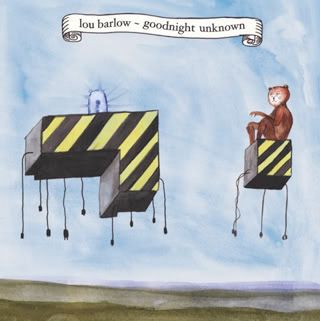
Lou Barlow - Goodnight Unknown (2009, Merge)


Lou Barlow, who most people know as one-third of newly reunited alt-rock gods Dinosaur Jr., is one of those prolific musicians who's way ahead of his game. After being fired from the band due to a public fallout with bandmate J Mascis, Barlow spent the nineties pursuing solo projects under both his own name and the monikers Sebadoh and Sentridoh. While the material released under such projects served as an awesome and very withstanding foundation for music in the days of burgeoning lo-fi craziness, the stuff he's released under his own name is far more developed and distinguished with an edge only Barlow can create. This trend continues with Goodnight Unknown, which will be released October 6th on Merge records.

As a whole, Goodnight Unknown proves to be one of Barlow's more polished efforts – one the man himself describes as “a cross between my later work with Folk Implosion and my earlier work with Sebadoh...to my ears, anyway.” In deep contrast to 2005's Emoh (a primarily acoustic gem), Unknown is a surging, full-fledged production, from the first chords on the pulsating opening track to the last murmurs on “One Note Tone.” It is also a highly collaborative work, with the Melvins' Dale Crover providing commendable drum work and new producers Lisa Germano and Andrew Murdoch helping the album retain an uniquely appealing energy. Another realization that comes to mind when taking in bits and pieces of Barlow's lengthy catalog (Goodnight Unknown and his Mirror the Eye EP, in particular) is that the bass player from one of the noisiest punk/alternative bands in history can still create songs so deep and mellow that they are just as touching as material on albums released by late singer-songwriter Elliott Smith. It is this characteristic that makes Barlow's work stand out from that of his colleagues, and this is also an element that makes Unknown one of his best works.

The opener, “Sharing,” encompasses most of the album's drive right off the bat. It's a smooth, well-executed pop song, punctuated by Crover's oscillating drums that are vaguely reminiscent of rhythms used by Bloc Party's Matt Tong. The tempo slows down briefly with “Goodnight Unknown,” but picks up gradually through the next three or four tracks. Staples of the album include “Thinking,” a melodic pop tune with noticeably haunting qualities, and “Praise,” which carries heavy strumming laden with crusading verve. Finally, Unknown concludes well with “One Note Tone,” which is nothing short of a perfect summary, possessing an equal amount of drive, depth, and production. But it's difficult to isolate these songs one by one to analyze the agenda or stylings of each – the whole album is a story, and should be listened to as one cohesive work rather than selected intermittent tracks.

Those expecting Barlow to return to the insane and quirky sounds of Sebadoh's 1991 album III will be disappointed by this album due to its conventional nature and refined sound, but devout Barlow fans and sensible music enthusiasts will treasure it as another gem from a very gifted (and very eclectic) indie demigod.

(Oh, and check out this tidbit!)

Tuesday, September 15, 2009

Yo La Tengo - Popular Songs (2009, Matador)


Sensible, musically-inclined and usually talented individuals who are romantically involved with one another know that it's not an awesome idea to start a band together. There is always the possibility of that “big break,” and even though we've come to know that phrase in terms of fame, it can also be synonymous with a split in a seemingly invincible relationship from which that outfit was fostered. However, a few couples have been able to withstand the pressures of music and marriage - see Dan Boecker and Alexei Perry of Handsome Furs, Thurston Moore and Kim Gordon of Sonic Youth, and Chris Frantz and Tina Weymouth of Talking Heads. Ira Kaplan and Georgia Hubley, two-thirds of indie rock pioneers Yo La Tengo, not only join these ranks – they surpass them, and their latest album, Popular Songs (released earlier this month on Matador Records), cements such a rarely made statement.

Popular Songs puts their last album, 2006's I Am Not Afraid of You and I Will Beat Your Ass, to shame. While Beat Your Ass is great because of the minimalistic production and appropriated noise, Songs makes a bigger statement by possessing all the characteristics of a genuinely romantic album while staying true to Yo La Tengo disposition. The opener, “Here to Fall,” begins with sounds that carry an Animal Collective likeness, until a slew of strings sweep in as perfect accompaniment not only to the vocals, but to the instrumentation found on later tracks. As one makes their way towards the middle of the album, they will notice that it's similar to an iTunes library on shuffle, especially after going from the energetic, radio-friendly “Nothing to Hide” to the Zombies-esque “Periodically Triple or Double” - nothing short of a musical and lyrical potluck. However, the heart of the album lies within the last few songs. When “All Your Secrets” segues into “More Stars than There Are in Heaven,” we come face to face with Yo La Tengo creating unpretentious, meaningful post-rock; while Godspeed You! Black Emperor brought post-rock to music snobs everywhere, Yo La Tengo does it better, not only by means of ethereal instrumentation and an essence of honest passion, but also by realizing that normal people can't sit through a twenty-two minute song with six or seven movements contained therein. The notable finisher, “And the Glitter is Gone,” is a track heavy with distortion pedals, shoegaze influence, and a feeling of enchantment. It serves as an excellent wrap-up because it does exactly what it's supposed to do: sum up the spirit of the album without being excruciatingly repetitive or belaboring.

As a whole, this album is a manifesto to unspecific, long-lasting love. From start to finish, Kaplan and Hubley metaphorically and musically guide us through a copious amount of emotions. Everything from lust to sadness is contained within these precious seventy-three minutes. It is an honest, relatable testament to how deep love can lie within a given pair of individuals. Undoubtedly, Popular Songs is one of the decade's best albums, and while you might not be falling in love yourself, it's not difficult to fall in love with them.

(Also, take a look at Pitchfork's article on the phenomenal album art!)

Vivian Girls - Everything Goes Wrong (2009, In the Red)


The decade has given us a lot of artists that have tried excruciatingly hard to make their musical catalog as open as possible, which has brought forth an audaciously hip music scene. Any arrangement of animal noises can be made into an LP and filed under “experimental,” which has sadly become just as generic as “alternative.” However, through the bloated mess of GarageBand electrosynth comes a resurgence in lo-fi that falls back on core aspects of punk rock, with bands comprised of young hotheads on stage who break guitar strings and sing-spit into their mics. It is this movement that created and continually praises Vivian Girls, a hodgepodge that's wedged somewhere between My Bloody Valentine and Wipers – their mission: to revive the stripped down proto-punk aesthetic in an era of lengthy post-rock and existentialist drone. Their sophomore effort, Everything Goes Wrong, takes the band's prime elements and doubles them, making it the better of the Girls' two releases.

Purists who are critical of Vivian Girls carry a template of statements regarding the trio's sound: “They can't play! It's all the same!” But these critics are missing the point: the simplicity of Vivian Girls is what makes them an excellent band. They belt out songs about general angst with a great amount of edge – an straightforward approach that proves enjoyable. This, in addition to the acclaim following their first album, caused Everything Goes Wrong to be well-anticipated; there aren't any music geeks in the country that can pass up this quirky, naked noisefest.

Compared to their 2008 debut, Wrong is longer in length and explores darker themes – a statement Cassie Ramone, Kickball Katie, and Frankie Rose have no trouble proving. The band immediately launches their listeners into their unpolished sound with “Walking Alone at Night,” an ironic number because of the dark title and bouncy feel . From there, we segue into the tracks “I Have No Fun” and “Can't Get Over You,” songs that give off a Ramones vibe because of their blunt lyricism. However, with the start of “Tension,” the energy ceases, and the band takes a sharp turn into a song that is, more or less, an eerie ode to their shoegaze influences. At almost three minutes, the eye of the storm doesn't last long: they're back to immersing their listeners in feedback by the next track. Most of the album continues in this fashion, with the two girls lending their lackadaisical vocals and guitars as accompaniment to Rose's drumming. However, the speed ceases for the final time with the conclusion, “Before I Start to Cry,”a sad piece with unworldly vocals and haunting guitars รก la Jim Reid – a perfect finish to a near perfect work.

The one problem with this album, as with most lo-fi, is that it can get monotonous; there's an implication that the material will ultimately be better when it's performed live, because the energy would manifest itself in physical form – after all, listening to the Stooges' debut album doesn't compare to seeing Iggy Pop strut around maniacally on stage. But listening to the album by one's lonesome proves less gripping, and therefore less stimulating.

However, Wrong's fault is easy to oversee. It's become undeniably clear that Vivian Girls are this decade's quintessential noise rock act, and while the existence of another release is pending, we can still look to Wrong to deliver that unique Vivian Girls sound that teaches us to opt for the simple instead of the complicated.

(Writer's note: This will be appearing in the 9/23 issue of the Forum. Also, this is the last time I'll use the word "hodgepodge" for a while, no matter how much I like it because it sounds like the name of my favorite glue.)

Tuesday, July 28, 2009

Teenage Jesus and the Jerks - Everything (1995, Atavistic)


When the Sex Pistols formed in 1975, they thought themselves to be punks. Punks with a sense of nihilism, elemental comedy, and an obvious disdain for authority - a rocky hodgepodge of booze, rage, and spit. Most punk rock bands felt themselves led by the Pistols. Thus, they followed, in large, angry packs of wild dogs. But American No Wavers weren't just dogs - they were wolves. They came together in the chaos of mid-70s NYC and created their own noisy howl that was not only unlike their English counterparts, but something entirely different in terms of awakening the senses. From this emerged Lydia Lunch and furthermore, Teenage Jesus.

Teenage Jesus and the Jerks was formed in 1976 by Lunch and her companion James Chance,individuals who were later to became two of the biggest and most influential names in noise (Chance would later form the Contortions as well as James White and the Blacks, while Lunch went on to do solo work as well as material with Sonic Youth's Thurston Moore). But because Teenage Jesus underwent tumultuous line-up changes and sporadic recording schedules (essentially a live band), their catalog was slim. These rarities disappeared in the eighties and were very much forgotten by nearly everyone except for Lunch, Chance, guitarist Jim Sclavunos, and a few purists in New York City that were holding onto misrepresented Dadaist ideals. It wasn't until a decade or more later that these lawless recordings were revisited and compiled into Everything, which was released in 1995 and continues to be black, white, and red all over.

Everything
opens with the twenty-two second, fast-paced "Red Alert," a prelude to forthcoming insanity. The "riffs" are reminiscent of those used in many tracks from punkers Chaotic Dischord, and while it is egregious noise, it may still be considered subtle in comparison to the tracks that follow. "Orphans," the first true track on the album, is considered a Teenage Jesus staple. Lunch howls and screams her way through a steady drum beat and excruciating guitar feedback, painting a portrait of small children with blood-covered feet running through trenches of snow. Subsequently, the songs continue in this fashion, varying in tempo and in faux instrumentation. The lyrics are hard and seemingly soulless with an unmistakable edge, to the point where you can visualize Lunch's vocal energy teeming through gritted teeth. "Freud in Flop" serves as an interlude to a few redundant tracks with instrumentals similar to that of proto-punk precursors. The album wears on until it reaches "Less of Me," a track featuring prominent and characteristic Chance saxophone and (almost) melodic repetition - another favorite among fans. "Red Alert (MK II)," a follow-up to the album's beginnings, fulfills its purpose as an ending by including a short, strangely normal bit of guitar before making a segue into small but vicarious applause.

In all its art-punk, glass-breakin' No Wave glory, Everything disappoints; not because of the material itself, but because of the selection of songs. While it houses the group's most notable singles and the infamous Pink EP, it simply does not deliver all of the band's recordings. Enthusiastic fans know all too well that Teenage Jesus recorded many different versions of their songs, and some consider a compilation like Everything to be sacrilege simply because it's not home to what it claims: everything. So if one is looking for "new" material, Everything is something to gather dust on the shelf if Pink and the seldom found 7" singles are already in your possession.

However, collection and bragging purposes aside, the album certainly delivers in terms of what you look for in Teenage Jesus and their nonconforming No Wave peers. Not only does it possess charisma and an unparalleled energy, but it also holds turmoil, anarchy, and the sense of pandemonium that could only be felt in New York during the mid to late 1970s. Oh, and howling. Don't forget the howling.